| Sector | Manufacturing |
|---|---|
| My Role | MES Expert, Team Lead |
| Team Size | 3 |
| Budget | Company Asset |
| Duration | 6 Months |
| Technologies | Angular JS, c#, Chat GPT, DDD (Domain Driven Design), Docker, React, SQL |
Description
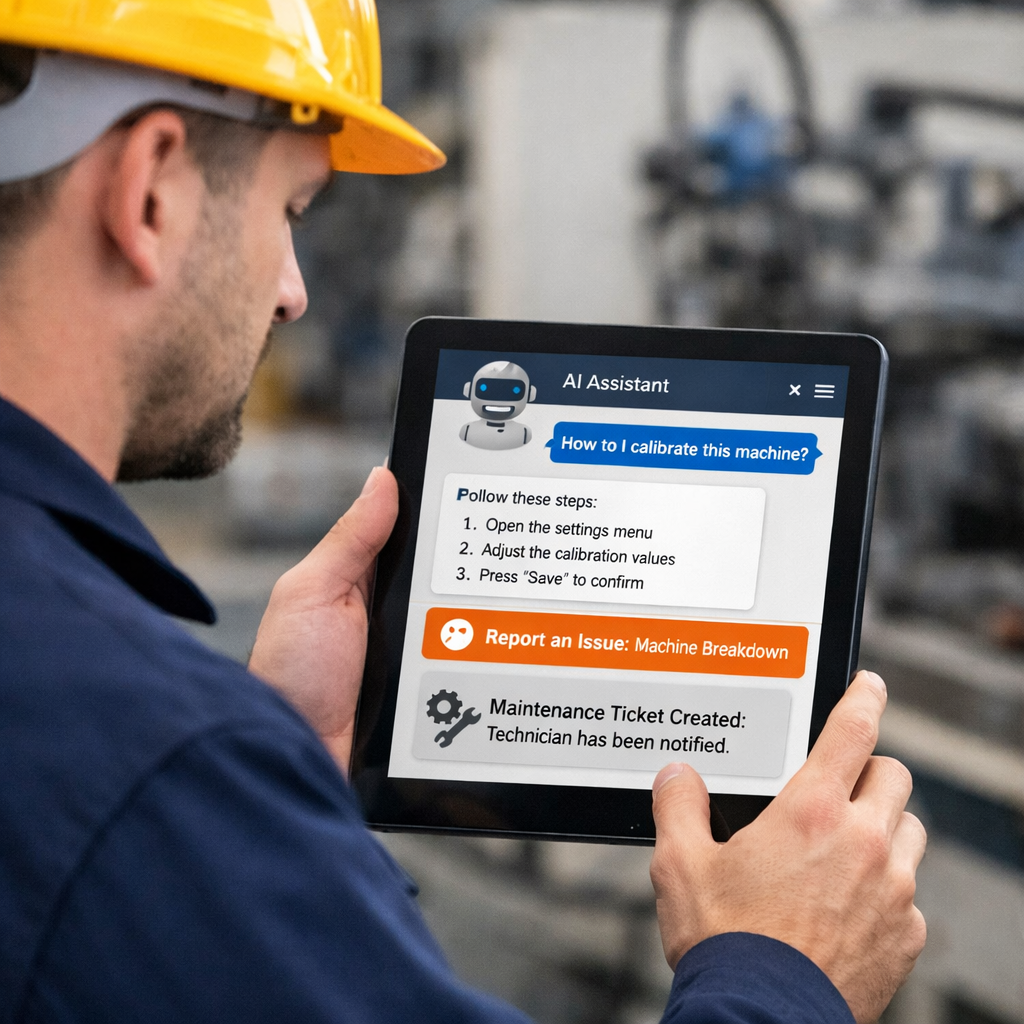
Talk to the Factory was created to support shopfloor workers directly in their daily production activities. Operators are often responsible not only for executing manufacturing tasks, but also for reacting to unexpected situations, clarifying process questions, and reporting incidents that affect production flow. In many factories, this still depends on reading long operating instructions, searching through documentation, or interrupting more experienced colleagues for support.
To solve this, we implemented an AI agent directly integrated into the shopfloor system. The solution allowed workers to ask practical production-related questions in natural language and receive contextual answers based on the manufacturing environment. At the same time, the agent could also trigger structured incident workflows, for example for maintenance requests, production interruptions, or other operational issues that needed to be documented and escalated.
The result was a much more accessible and efficient support layer for production staff. Instead of forcing operators to navigate extensive documentation or depend on senior personnel for every uncertainty, the system provided immediate guidance and enabled incident reporting directly from the place where the problem occurred. This reduced friction in daily operations and helped make production support faster, more consistent, and easier to scale.
Business Value
The project delivered value both on the operational and organizational level by improving how information and incidents were handled on the shopfloor:
- Faster problem resolution by giving workers direct access to relevant production knowledge through natural language interaction.
- Reduced dependency on senior staff for routine questions, allowing experienced employees to focus on higher-value tasks.
- Improved production efficiency by minimizing delays caused by unclear work instructions or missing information.
- Structured incident reporting through AI-triggered workflows for maintenance, interruptions, and other production events.
- Better documentation quality because incidents were captured directly in the system instead of being reported informally or too late.
- Higher usability for operators by replacing complex manual searches through long manufacturing documentation with a simple conversational interface.
Overall, the solution created a more responsive and scalable support process on the shopfloor, helping production teams work with greater confidence, speed, and consistency.
Approach
The solution was built around an AI agent based on ChatGPT and embedded directly into the existing shopfloor environment. The first step was to provide the agent with the relevant manufacturing context, including process-related knowledge and historical incident reports, so that answers could be grounded in the real operational environment instead of generic AI responses.
To make the agent truly useful in production, it was also connected to multiple production databases. This gave it access to the operational data required to understand the current context and retrieve the information needed to answer worker questions in a practical way. As a result, the agent was not only able to explain how a task should be performed, but also to respond based on the real state of the production system.
In addition to answering questions, the solution was designed to actively support operational workflows. For this reason, hooks were implemented so the AI agent could trigger downstream system actions whenever an incident needed to be reported. This allowed the conversational layer to become more than a support interface: it became an active entry point into structured factory processes such as maintenance or interruption handling.
The overall approach combined generative AI, manufacturing context, and system integration in a pragmatic way, ensuring that the solution was not an isolated chatbot, but a functional extension of the shopfloor system itself.
Technologies
The solution was built on top of my own MES platform, PST, which served as the technical foundation for the project. The architecture followed a microservice-based approach, with the AI agent implemented as an isolated microservice to keep the solution modular, maintainable, and easy to evolve independently from the rest of the platform.
The backend stack was based on the .NET ecosystem, including C# and ASP.NET, while the frontend used a combination of Angular and React.js. This setup made it possible to integrate the AI capabilities directly into the existing shopfloor application landscape while keeping the overall solution aligned with modern enterprise development practices.
Additional information
| Budget | Company Asset |
|---|---|
| Duration | 6 Months |
| Sector | Manufacturing |
| My Role | MES Expert, Team Lead |
| Team Size | 3 |
| Technologies | Angular JS, c#, Chat GPT, DDD (Domain Driven Design), Docker, React, SQL |