| Sector | Logistics, Manufacturing |
|---|---|
| My Role | CTO, Lead Developer |
| Team Size | 5 |
| Budget | Company Asset |
| Duration | 10 Years |
| Technologies | Angular JS, c#, DDD (Domain Driven Design), Entity Framework, Ninject, Non SQL, React, SQL |
Description
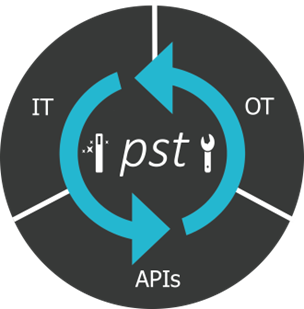
As Founder and CTO of M2MGO, I led the conception, architecture and long-term development of our core product: PST – People · Systems · Things.
PST was a full M2M / IoT SaaS platform designed to connect machines with people – and to give companies the tools to build their own digital workflows on top of real-time machine data.
We founded the company together with the telecommunications incubator hubraum, and secured €500,000 in Microsoft funding to build and scale the platform on Microsoft Azure. From day one, PST was architected as a cloud-native, multi-tenant system with enterprise integration capabilities.
Over 10 years, we built, operated and continuously evolved the platform – serving both SaaS customers and on-premise installations.
The Business Value
The core idea behind PST was simple:
Machines produce data.
People need applications.
Companies need digital processes.
With PST, our clients could create digital workflows using a drag-and-drop editor – without writing code. These workflows collected, processed and visualized machine data and combined it with manual inputs and enterprise systems.
Typical use cases included:
-
Fleet tracking & tracing
-
Shopfloor digitization (PDA applications)
-
Production Data Acquisition (PDA / MDE / BDE)
-
Custom IoT applications
-
Machine integration scenarios
-
Digital process orchestration in manufacturing environments
Instead of isolated dashboards, PST enabled real business applications that connected operational technology (OT) with IT and users.
The Architecture – Four Core Building Blocks
1. Machines – The IoT Stack (MQTT & Data Ingestion)
At the time we founded the company, MQTT implementations were still rare and immature. We implemented the protocol stack ourselves and built a complete ingestion pipeline from scratch.
Key aspects:
-
Custom MQTT-based communication layer
-
Secure device authentication
-
High-throughput data ingestion
-
Real-time processing pipelines
-
Scalable Azure-based infrastructure
This allowed us to reliably connect machines, sensors and embedded systems and stream their data into the platform.
2. Apps – A Custom WYSIWYG Business App Editor
One of the most innovative parts of PST was our custom-built “What You See Is What You Get” editor.
Clients could:
-
Design business applications visually
-
Define workflows
-
Combine machine data with manual inputs
-
Build not only dashboards, but full operational apps
-
Deploy web-based applications instantly
This was not just reporting – it was digital process creation.
Applications were web-based, responsive and ready to use on shopfloor devices, tablets and desktops.
3. People – Multi-Tenant User & Role Management
PST was built as a multi-tenant SaaS platform.
We implemented:
-
Role-based access control (RBAC)
-
Fine-grained permissions
-
Enterprise integration (e.g. Active Directory)
-
Tenant separation and data isolation
Users could perform actions based on their privileges – from shopfloor operators to supervisors and management.
4. Systems – Manual Entities & Visual Data Modeling
Not all company data comes from machines.
To address this, we built a visual database management layer that allowed clients to:
-
Define manual entities
-
Model their own structured data
-
Connect to enterprise data silos
-
Combine business data with IoT data
All defined entities became immediately available in the app editor, enabling true cross-system process modeling.
Technology Stack
PST was developed and maintained over a decade with continuous evolution:
Backend
-
ASP.NET (initially .NET Framework)
-
Migration to .NET Core
-
C#
-
SQL Server
-
Azure infrastructure
Frontend
-
AngularJS (initial phase)
-
Migration to React
-
Custom UI framework for the editor
Architecture & Quality
-
Multi-tenant SaaS architecture
-
On-premise deployment variants
-
CI/CD pipelines
-
Unit tests and integration tests
-
Long-term maintainability focus
My Role as Founder & CTO
In m2mgo, I acted as:
-
Founder
-
CTO
-
Lead Developer
-
Team Leader
-
Architecture Specialist
My responsibilities included:
-
Defining the overall system architecture
-
Leading and mentoring the development team
-
Ensuring code quality and long-term maintainability
-
Designing and supervising the IoT communication layer
-
Managing SaaS operations and cloud infrastructure
-
Overseeing migrations (Angular → React, .NET Framework → .NET Core)
-
Ensuring stable operations for both SaaS and on-premise customers
Over 10 years, I was responsible not only for building the platform, but for keeping it operational, scalable and evolving alongside customer requirements.
What This Means Today
Building PST from scratch gave me deep expertise in:
-
IoT & M2M architectures
-
MQTT-based machine communication
-
SaaS platform design
-
Multi-tenant enterprise systems
-
MES / MOM integration scenarios
-
Shopfloor digitization
-
Enterprise user and role models
-
Long-term software lifecycle management
It also shaped my mindset:
Systems must be scalable.
Architecture must be clean.
Software must survive years – not months.
If you are looking for someone who has built and operated complex industrial SaaS platforms end-to-end, PST is the proof.
Additional information
| Budget | Company Asset |
|---|---|
| Duration | 10 Years |
| My Role | CTO, Lead Developer |
| Sector | Logistics, Manufacturing |
| Technologies | Angular JS, c#, DDD (Domain Driven Design), Entity Framework, Ninject, Non SQL, React, SQL |
| Team Size | 5 |