

Right after leaving my job at Accenture, something interesting happened.
There was suddenly space again. Not just on the calendar, but in my head. And once you notice that, you also notice all the “long due” things at home that have been waiting patiently in the background.
One of them had been requested for a while — loudly and repeatedly — by the two youngest members of our household.
I have three daughters, and they share one room. Eight years ago, together with my dad and a couple of friends, we built the first loft bed for my oldest daughter. It was a classic “let’s do this properly” weekend project: wood, screws, measurements, teamwork, and the kind of satisfaction you only get when something becomes real.
But time passes.
And for at least a year, the other two have been asking the obvious question:
“So… when do we get ours?”
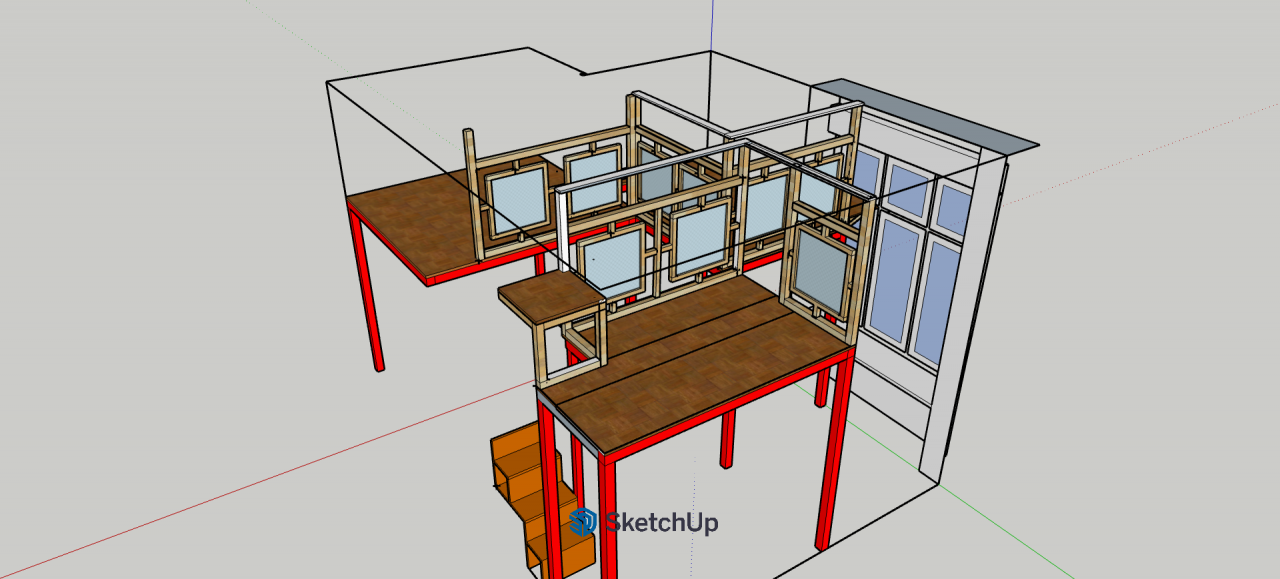
From “idea” to “model”: planning with SketchUp
I’m a hobby woodworker. I’m not a carpenter, and I don’t pretend to be one — but I love wood as a material. It’s honest, forgiving in some areas, brutally precise in others, and it rewards patience and preparation.
So before touching a single plank, I started where I usually start: planning.
I opened SketchUp and began modeling the new setup. Not just a rough sketch, but a proper model that forced decisions early:
-
dimensions that actually fit the room
-
ladder positions
-
safety rails
-
storage and access
-
how everything connects and stays stable
At that stage, it looked good — at least on my screen.
But the difference between “looks good” and “works well” is where iteration begins.
Design iteration with Vera
This is where I got lucky.
My friend Vera — product designer, sharp mind, and someone who sees problems before they exist — joined the process. (Formerly @VeraPrimavera.)
We iterated the design: again and again, pushing it from “a nice DIY bed” toward something cleaner, safer, and more thought-through.
This part is underrated in DIY projects: the best time to change your mind is when the project is still pixels.
One week with my dad: the heavy lifting
Then came the best part.
My dad flew over and helped me for a full week. That week was the core of the build — the heavy lifting, the big cuts, the structural parts. The kind of work that feels intense during the day and incredibly satisfying in the evening.
Working with my dad on projects like this always brings a special mix:
-
experience meeting enthusiasm
-
“old-school” craftsmanship meeting modern tools
-
and a shared focus on doing it right, not fast
Two more weeks: finishing, details, reality
After my dad left, the project was standing — but not finished.
Finishing work is where reality lives:
-
small adjustments that only appear when you assemble things for real
-
edges, sanding, alignment
-
final stability checks
-
the details that turn a construction into a piece of furniture
It took me about two more weeks to complete everything properly.
Tools, time, and why I love this kind of project
Over the years I’ve gathered a pretty decent set of tools, and my workshop is now good enough to take on projects like this without improvising too much. Not because I’m trying to become a professional woodworker — but because I genuinely enjoy it.
This build ended up being:
-
about one month of happy planning with friends and family
-
and one month of building (with a big part done together with my dad)
And honestly: it was exactly the kind of “after Accenture” project I needed.
Not a CV bullet point. Not a client deliverable. Just real work, with real people, creating something that will be used every day.
The final result
The best feedback wasn’t a compliment.
It was simply the moment the kids moved in and treated it like it had always been there.
That’s the ultimate sign that a project worked: it becomes part of life.